- The Solar System
- Movements of the Earth
* Revolution and rotation.
- The Moon and its phases.
- Eclipes:
* Solar and lunar.
- Stars and their properties.
- Galaxies and constellations.
The Sun is the largest celestial body. It is much bigger than any planet. It is at the centre of the Solar System. The Sun is an enormous yellow star which provides the light and heat necessary for life on Earth. The Sun rotates on its own invisible axis.
Planets and satellites. There are eight large celestial bodies called planets. Each planet rotates on its own invisible axis. Each planet also orbits the Sun. The planets can be classified into two groups: terrestrials and gas giants.


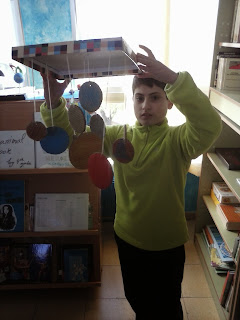


Asteroids. In the Solar System, there are thousands of tiny, rocky celestial bodies called asteroids. They have different shapes.
Comets are small celestial bodies make up of ice, dust and rock. They have bright tails which point away from the Sun. We can only see the tail of a comet when it is close to the Sun.
Stars
Exercise
1.- Write true or false.
a.- The Sun is an enormous yellow planet.
b.- The Sun rotates on its own invisible axis.
c.- All the planets orbit the Sun.
d.- Terrestrial planets orbit the Sun.
e.- Asteroids are natural satellites.
f.- Comets are made up of ice, rock and dust.
2.- Investigate
- Why is the Sun bright?
- Do all the planets have moons?
3.- Comprehension.
Match the two halves of each sentence.
- Movements of the Earth
* Revolution and rotation.
- The Moon and its phases.
- Eclipes:
* Solar and lunar.
- Stars and their properties.
- Galaxies and constellations.
The Solar System
http://www.primaryresources.co.uk/science/powerpoint/Solar_system_and_beyond.swf
http://www.glencoe.com/sites/common_assets/science/virtual_labs/E28/E28.swf
The Solar System consists of the Sun, eight planets and their moons. They are all called celestial bodies. Everything in the Solar system orbits the Sun.http://www.primaryresources.co.uk/science/powerpoint/Solar_system_and_beyond.swf
http://www.glencoe.com/sites/common_assets/science/virtual_labs/E28/E28.swf
The Sun is the largest celestial body. It is much bigger than any planet. It is at the centre of the Solar System. The Sun is an enormous yellow star which provides the light and heat necessary for life on Earth. The Sun rotates on its own invisible axis.
Planets and satellites. There are eight large celestial bodies called planets. Each planet rotates on its own invisible axis. Each planet also orbits the Sun. The planets can be classified into two groups: terrestrials and gas giants.


Asteroids. In the Solar System, there are thousands of tiny, rocky celestial bodies called asteroids. They have different shapes.
Comets are small celestial bodies make up of ice, dust and rock. They have bright tails which point away from the Sun. We can only see the tail of a comet when it is close to the Sun.
Stars
A star is a spherical body which generates light and heat
through nuclear reactions. Most stars consist of the gases
hydrogen and helium.
Stars have different characteristics:
• Colour: depending on their temperature, stars can be red,
orange, yellow, white or blue.
•Size: all stars are enormous, but some are larger than others.
•Luminosity: this refers to the amount of light from the star which reaches the Earth.
Constellations
Stars are divided into eighty-eight groups or constellations to make identification easier. The constellations have the names of characters from classical mythology or the names of animals and objects because of the shapes they form.
Some constellations, such as Ursa Major, can be seen all year.
However, Orion, for example, can only be seen in winter, and Hercules can only be seen in summer.
Nebulae
A nebula is a cloud of dust and gas. Some nebulae are illuminated by stars near them. New stars are formed in some nebulae.
Galaxies
Galaxiesare enormous groups of stars, gases and dust.
There are three types: elliptical, spiral and irregular
.
Our Solar System is on the edge of a galaxy called the Milky Way.
All the stars which we can see belong to this galaxyExercise
1.- Write true or false.
a.- The Sun is an enormous yellow planet.
b.- The Sun rotates on its own invisible axis.
c.- All the planets orbit the Sun.
d.- Terrestrial planets orbit the Sun.
e.- Asteroids are natural satellites.
f.- Comets are made up of ice, rock and dust.
2.- Investigate
- Why is the Sun bright?
- Do all the planets have moons?
3.- Comprehension.
Match the two halves of each sentence.
1. Most stars consist of a. on the edge of the Milky Way.
2.Temperature b. 88 constellations.
3.Stars are not c. hydrogen and helium.
4.Constellations are d. in winter.
5.Stars can be grouped into e. affects the colour of a star.
6.Orion can only be seen f. all the same size.
7.A nebula is g. groups of stars.
8.Our Solar System is h. a cloud of dust and gas
The Solar System
Mars ◆ Mars is the fourth planet from the Sun in the Solar System. It has two tiny moons,
Phobos and Deimos, which orbit very close to the planet.
The planet is named after Mars, the Roman god of war. It is also known as the ‘red planet.’
Its red colour comes from iron oxide which covers the planet with fine red dust.
The geographical features of Mars are similar to those of Earth. It has craters, volcanoes,
valleys, deserts and polar ice caps. It has the highest known mountain in the Solar System –
Olympus Mons – and also the largest canyon, Valles Marineris.
Mars is a terrestrial planet with a thin atmosphere. There is
some evidence that Mars has liquid water and may have had
some form of life in the past.
Mars has approximately half the radius of Earth. Its average
distance from the Sun is about 230 million kilometres. The
Solar day on Mars is only slightly longer than an Earth day: 24
hours, 39 minutes, 35.244 seconds. A Martian year is equal to
1 year, 320 days and 18.2 hours.
1. Match the words and definitions.
a. tiny 1. a very big hole
e. crater 2. a permanent area of ice
c. iron oxide 3. very small
g. canyon 4. in a small way
b. to orbit 5. connected with the Earth
f. ice cap 6. a chemical compound
d. dust 7. to go around
h. terrestrial 8. fine powder
i. slightly 9. a very deep valley
2. Correct the information.
a. Mars is the closest planet to the Sun.
b. Mars has three moons.
c. The planet is named after a Greek god.
d. Mars looks red because of its sunsets.
e. Mars is a very flat planet.
3. Choose the best answer.
a. The moons of Mars travel very near:
1. the Earth 2. the Sun 3. Mars
b. Photographs of Mars show:
1. a varied landscape 2. old ruins 3. early forms of life
c. To sustain life, a planet needs:
1. craters 2. a thin atmosphere 3. water
d. Mars takes over a year:
1. to go round the Sun 2. to go round the Earth 3. to turn round completely
4. Write complete sentences.
a. Galileo / look at Mars / telescope / 1609
b. lot of storms / Mars.
c. NASA has sent / many space missions / Mars
d. nobody / sure / life on Mars.
5. Investigate.
Find out some information about another planet.
Write a paragraph about it.
Use the text about Mars to help you.
En este enlace encontrarás un montón de información sobre los planetas y sus lunas.
http://www.mysciencekit.com/flash/solarsystem.swf
The Solar System
Mars ◆ Mars is the fourth planet from the Sun in the Solar System. It has two tiny moons,
Phobos and Deimos, which orbit very close to the planet.
The planet is named after Mars, the Roman god of war. It is also known as the ‘red planet.’
Its red colour comes from iron oxide which covers the planet with fine red dust.
The geographical features of Mars are similar to those of Earth. It has craters, volcanoes,
valleys, deserts and polar ice caps. It has the highest known mountain in the Solar System –
Olympus Mons – and also the largest canyon, Valles Marineris.
Mars is a terrestrial planet with a thin atmosphere. There is
some evidence that Mars has liquid water and may have had
some form of life in the past.
Mars has approximately half the radius of Earth. Its average
distance from the Sun is about 230 million kilometres. The
Solar day on Mars is only slightly longer than an Earth day: 24
hours, 39 minutes, 35.244 seconds. A Martian year is equal to
1 year, 320 days and 18.2 hours.
1. Match the words and definitions.
a. tiny 1. a very big hole
e. crater 2. a permanent area of ice
c. iron oxide 3. very small
g. canyon 4. in a small way
b. to orbit 5. connected with the Earth
f. ice cap 6. a chemical compound
d. dust 7. to go around
h. terrestrial 8. fine powder
i. slightly 9. a very deep valley
2. Correct the information.
a. Mars is the closest planet to the Sun.
b. Mars has three moons.
c. The planet is named after a Greek god.
d. Mars looks red because of its sunsets.
e. Mars is a very flat planet.
3. Choose the best answer.
a. The moons of Mars travel very near:
1. the Earth 2. the Sun 3. Mars
b. Photographs of Mars show:
1. a varied landscape 2. old ruins 3. early forms of life
c. To sustain life, a planet needs:
1. craters 2. a thin atmosphere 3. water
d. Mars takes over a year:
1. to go round the Sun 2. to go round the Earth 3. to turn round completely
4. Write complete sentences.
a. Galileo / look at Mars / telescope / 1609
b. lot of storms / Mars.
c. NASA has sent / many space missions / Mars
d. nobody / sure / life on Mars.
5. Investigate.
Find out some information about another planet.
Write a paragraph about it.
Use the text about Mars to help you.
En este enlace encontrarás un montón de información sobre los planetas y sus lunas.
http://www.mysciencekit.com/flash/solarsystem.swf


